The Humanitarian Crisis in Syria

POST WRITTEN BYProf. Peter Widulski, Assistant Director of the First Year Legal Skills Program and the Coach of International Criminal Moot Court Team at Pace Law School.

An article in the New York Times on October 6, 2015 on the conflict in Syria states that the conflict “has left 250,000 people dead and displaced half the country’s population since it started in 2011.”

This horrifying statement is contained in a dependent clause in a sentence in the sixth paragraph of an article on Russia’s intervention in the Syrian conflict. This placement unfortunately may reflect that the massive human suffering in Syria is becoming an afterthought to the quarrels among world powers regarding Syria.

What is happening to the people of Syria is difficult for most people to imagine. Americans will remember that thousands of their fellow citizens were displaced from their homes when Hurricane Katrina struck New Orleans in 2005. Most of these have returned home, but many have been unable to do so because what were their homes no longer exists.

The forced evacuation of a city like New Orleans is a frightening event. The present writer was one of those who experienced it. On the morning before the hurricane struck, I learned from radio reports that Katrina was not veering off, would hit the city in about 24 hours with great destruction, and all should evacuate. Not having a car, I stuffed some things in a kit bag, left my apartment in the Uptown District, and started walking toward downtown – not knowing where in particular I was going or what was going to happen to me. I managed to make my way to the Superdome, where about 25,000 others and I took shelter in harsh conditions for five days, before being evacuated.

The difficulties that my fellow refugees and I experienced at that time were as nothing compared to the terror and extreme hardships now being experienced by the people of Syria. We were evacuating our city, not our country. And our displacement was caused by a natural disaster, whose effects, for the most part, were temporary. It is a very different thing to be forced to flee not only your home, but also your country, because vicious people are more than willing to kill you and your family because of your political sympathies or because of your religious beliefs or because you just happen to be in the way.

The horrendous numbers of dead and displaced in Syria strongly support a conclusion that such massive suffering could not have happened without the commission of war crimes and crimes against humanity by participants in the conflict. Whether there will ever be investigation or prosecution of such crimes by the International Criminal Court is far from clear. The U.N. Security Council has authority under the ICC’s Statute and Chapter VII of the U.N. Charter to refer the Syrian situation to the ICC, but such referral is unlikely because of the veto power of one or more of the Council’s permanent members.

The Preamble of the ICC’s Statute articulates its ratifiers’ “[d]etermin[ation] to put an end to impunity for the perpetrators” of “grave crimes [that] threaten the peace, security and well being of the world.” It seems that regarding what is happening in Syria, this goal will remain for the moment a mere aspiration, and, as the quarrel among world powers intensifies, the suffering of the Syrian people will remain an afterthought.

Related Readings:

Is America Becoming a Nation of Ex-Cons?

POST WRITTEN BY: John Humbach, Professor of Law at Pace Law School.

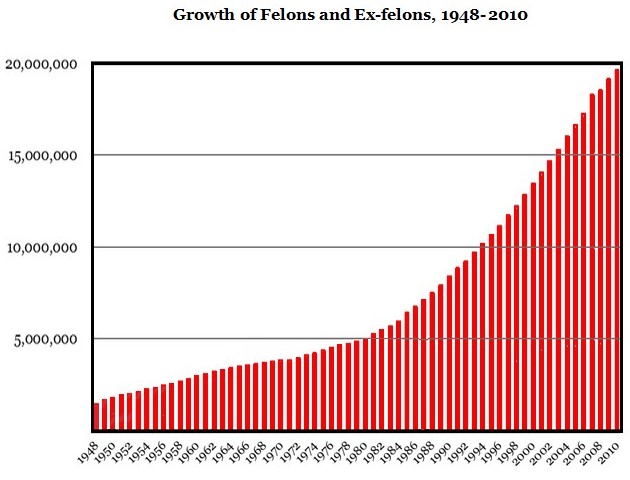
graphMuch has been written about the extraordinary rates of incarceration as a pressing criminal justice problem. Mass incarceration is, however, only part of the challenge posed by the American criminal justice system. Already, an estimated 25% of U.S. adults have a criminal record and, with a million new felony convictions per year—one every 30 seconds—America’s ex-offender population is growing exponentially (see chart to the right). Our country is well on its way to becoming a nation of ex-cons.

The effects of being a “criminal” do not, moreover, end with release from prison. Newly released inmates are immediately met by a growing assortment of law-prescribed “collateral consequences” that now number in the tens of thousands. In their cumulative impact, these legal disabilities greatly reduce the ability of ex-offenders to find housing, make a living, get an education, obtain bank loans, support their children or, generally, to enjoy the usual rights and amenities of citizenship that are essential for a reasonable quality of life.  As a result, our nation’s criminal-justice policy is literally re-making America into a legally divided multi-stratum society with an entrenched system of law-sanctioned discrimination against a large and growing underclass with a legally-prescribed inferior civic status.

Already, the ex-offender class is the nation’s largest legally discriminated-against minority group, and it is growing. The adverse social implications of this trend remain unclear and the critical demographic tipping point is still uncertain. But whatever the details, this is surely not good path for the nation to be on.

Graph Source: 

Related Readings: 

  • John Humbach, Is America Becoming a Nation of Ex-Cons?, 12 Ohio St. J. Crim. L. 605 (2015) (SSRN) (Pace Digital Commons).  

Prosecutor Accountability for Appellate Delays

DA Mary Rain recently had to defend an extensive appellate delay caused by one of the attorneys in her office.  Is there a better solution to extensive delays in criminal appeals?

Ukraine Expands Its Acceptance of ICC Jurisdiction

POST WRITTEN BYProf. Peter Widulski, Assistant Director of the First Year Legal Skills Program and the Coach of International Criminal Moot Court Team at Pace Law School.

Violence in Ukraine has troubled that nation and the world community for about two years. Recently, Ukraine has renewed and expanded its efforts to afford the International Criminal Court jurisdiction to investigate and prosecute those responsible for mass crimes committed on its territory. Ukraine is now alleging that Russia is responsible, in part, for such crimes.

Ukraine is not a State Party to the ICC’s Rome Statute. However, as written about in April 2014 post, Ukraine lodged an Article 12(3) declaration, which allows a non-Party State to accept the Court’s jurisdiction over crimes within its subject matter jurisdiction that are committed on the State’s territory. Ukraine’s 2014 declaration alleged that crimes against humanity were committed during internal strife in Ukraine between November 2013 and February 2014, responsibility for which it alleged was attributable to Ukraine’s former President and possibly other senior officials in his government. The ICC Prosecutor has been conducting a preliminary investigation regarding this matter but has not yet decided whether to seek authorization to open a formal investigation that would expand her investigative powers and allow for filing of charges against individuals.

Ukraine has now gone further. In a September 8, 2015 press release the ICC reported that the ICC Registrar acknowledged receipt of a second Article 12(3) declaration by Ukraine, in which Ukraine expands its acceptance of ICC temporal jurisdiction from beyond February 2014 to the indefinite future. Importantly, the declaration attributes responsibility for post-February 2014 war crimes and crimes against humanity to “senior officials of the Russian Federation and leaders of terrorist organizations.” Thus, Ukraine’s second declaration opens a politically potent issue, asking the ICC Prosecutor to conduct at least a preliminary investigation into Russia’s alleged involvement in the violence in Ukraine.

In its September 8 press release, the ICC noted that “[t]he provisions of Part 9 of the Statute relating to international cooperation and judicial assistance apply.” Part 9 of the Rome Statute imposes on State Parties the responsibility “to cooperate fully with the Court in its investigation and prosecution of crimes within the jurisdiction of the Court.” The Russian Federation, however, is not a State Party to the Rome Statute, and thus has no such responsibility to the ICC.

It will be interesting to see how this matter will develop.